Detailed description of the article selection process
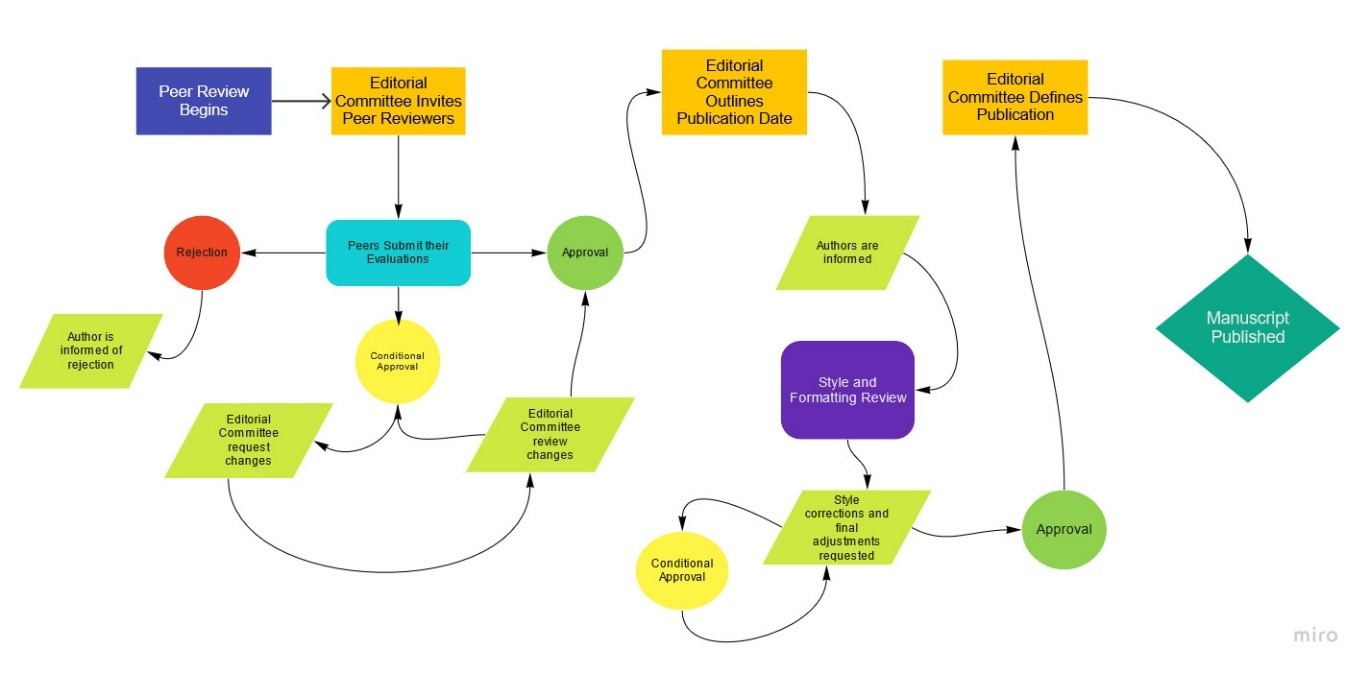
The following outline summarizes CUHSO’s peer review process.
Pre-review
Authors begin the process by submitting their article through CUHSO’s OJS platform. At this stage, the editor, in collaboration with the Editorial Committee, conducts a preliminary assessment of the manuscript and evaluates:
- Content quality: relevance for the discipline, scientific character, interest of the topic, use (or not) of a scientific methodology and up-to-date references.
- Relevance in relation to the journal’s editorial scope.
- Compliance with the journal’s formatting and submission requirements. In case of non-compliance, the authors are informed and allowed to make corrections.
- Initial anti-plagiarism check. If a high level of similarity with other published texts is detected, the Editorial Committee will inform the authors of either the rejection of the manuscript or the possibility of resubmission after correction.
If the manuscript meets all criteria, it proceeds to the peer review stage.
Peer review
The Editor-in-Chief, in collaboration with the Editorial Committee, invites peer reviewers according to the following criteria:
- The reviewer has an academic background, research profile, and publications in the relevant field of knowledge.
- The reviewer has no conflict of interest that could affect the evaluation process.
Reviewers complete their assessment using an online form or a Word file and are encouraged to include comments or submit a copy of the manuscript with anonymized annotations.
The evaluation outcomes are:
- Rejected: the manuscript does not meet the criteria of relevance, originality, and quality.
- Accepted with major corrections: the article may be accepted after a second round of peer review.
- Accepted with minor corrections: the Editorial Committee requests changes from the authors. If these changes are incorporated, the article is accepted.
- Accepted: the article may be published.
In cases where the Committee deems it necessary, a third reviewer is consulted, and their opinion is taken into account in the final decision.
The final decision to publish rests with the Editorial Committee and requires compliance with the journal’s style guidelines and anti-plagiarism checks.
Authors whose articles have been approved with modifications and/or accepted for publication undertake to make content, formal, and stylistic corrections within 5 working days from the date of the request.
Step 1. Preliminary verification
Responsible person: Editor-in-Chief.
Outcome: the editor sends the author an e-mail either accepting the article to enter the peer review process, requesting modifications to the article, or rejecting the manuscript.
During preliminary verification, the following elements are checked:
- Whether the article falls within the thematic and methodological scope of the journal.
- Whether information on authorship, affiliation, and metadata is complete and reliable.
- Whether the document complies with the journal’s criteria (see the Author Guidelines).
- Whether the reference list is of adequate length, up to date, and composed of recognized sources including their DOI links.
- Whether the article has not been previously published in any other language.
- Whether the article follows good practices in scientific journal publishing and the ethical standards set out by COPE (Committee on Publication Ethics), Singapore Statement on Research Integrity y ELSEVIER: Publishing Ethics Resource Kit.
- Whether there is any evidence of plagiarism in the manuscript.
- Whether the manuscript meets minimum standards of style, spelling, and punctuation.
- Whether the article includes the required attachments, including the declaration of originality and the “CUHSO Authors’ Declarations” form.
Manuscripts with evidence of plagiarism, false information about the authors, or any other obvious ethical violation will be rejected immediately. Articles that fail to meet any of the other criteria (not related to plagiarism or ethical issues) will have the opportunity to submit a revised version within a defined deadline. Manuscripts that do not include the required documentation (declaration of originality and information form) cannot proceed to peer review until these requirements are met.
Online tracking:
Once an article is accepted to enter the peer review process, its status in the journal’s platform will change from “assignment pending” to “under review”. From that moment on, the author can monitor the status of the process under the “Review” tab.
The submission platform assigns a unique identifier to each article. When sending queries or e-mails, authors must ensure that this code is included in the subject line.
Step 2. Peer review
Responsible persons: Editor-in-Chief, Associate/Assistant Editor.
Time frame: the peer review process usually takes between 4 and 6 weeks, depending on the availability of the selected reviewers.
At CUHSO, article evaluation is carried out through peer review by experts who provide an informed assessment of the manuscript’s content (they are not members of the journal’s Editorial Team). CUHSO applies a double-blind review system, which means that authors and reviewers do not know each other’s identities. At least two reviewers are assigned to each manuscript. This ensures confidentiality and objectivity throughout the process.
The requirements and selection criteria for reviewers are:
- Holding at least a Master’s degree in the field related to the article.
- Having scientific publications in the relevant area during the last two years.
- Not being affiliated with the same institution as the article’s authors.
- Having no conflicts of interest with the journal or any of its members: authors, editors, committee members, or administrative staff.
Selected reviewers receive an invitation from the Editor-in-Chief or Associate/Assistant Editor to participate in the review process. Reviewers may accept or decline the invitation. If they accept, they gain access to the full anonymized manuscript and an online review form to guide their evaluation. The process is conducted via the journal’s OJS (Open Journal Systems) platform or through institutional e-mail.
In addition to the article’s topic and field, reviewers are asked to evaluate: the wording of the title, content and structure of the abstract, choice of keywords, content and structure of the introduction, methodology, level of argumentation, results, discussion, formulation of conclusions, and the overall impact and contribution of the article to its field.
The reviewer submits comments and general recommendations to improve the manuscript and issues a recommendation according to one of the following outcomes:
- Publishable without changes: the revised article meets all requirements and can be published as it is.
- Publishable with minor changes: the article requires minor corrections that can be easily implemented.
- Publishable with major changes: the article requires substantial revisions, and the new version, incorporating the authors’ changes, must be sent back for a new evaluation by the reviewers or Editorial Committee members.
- Not publishable (rejected): the article is not suitable for publication and would not contribute meaningfully to the relevant scientific field.
If there is a discrepancy between reviewers’ recommendations, the Editor-in-Chief (with the possible support of the Editorial Committee) will make the final decision.
The Editor-in-Chief will issue a review certificate for each reviewer corresponding to the issue in which they participated, to be sent by e-mail within one month after completion of the evaluation.
The journal welcomes any suggestions reviewers may wish to share with the Editor-in-Chief regarding review criteria and indicators, ethical issues, or recommendations for improving the process. Such suggestions may be sent to the journal’s editor, Dr. Matthias Gloël: mgloel@uct.cl.
Reviewers must follow COPE (Committee on Publication Ethics) guidelines and have the following responsibilities: contribute to the editorial decision, comply with deadlines, respect confidentiality, ensure objectivity, properly acknowledge sources, and disclose any conflicts of interest.
Step 3. Editorial decision
Responsible persons: Editor-in-Chief, Guest Editor (if applicable).
Once the Editor-in-Chief has received recommendations from at least two reviewers, they have 2 weeks to communicate the decision to the author.
The Editor-in-Chief may accept (publishable), reject (not publishable), or request additional revisions from the authors (publishable with minor or major changes). If the editor’s decision differs from the reviewers’ recommendations, it must be clearly justified.
The decision to publish may be delegated to Guest Editors (where applicable). Any editor with a conflict of interest will be excluded from the decision-making process.
The author receives an e-mail containing the editor’s decision, a summary of reviewers’ comments and suggestions, and a deadline to complete the revision process.
Online tracking:
The editor’s decision is reflected in a change of the manuscript’s status in the online platform. When the decision is “not publishable”, the article is immediately withdrawn from the review process, and details are stored in the “Archive” section.
Step 4. Authors’ revision
Responsible persons: the authors.
Time frame: once the editorial decision has been issued, the author has the following deadlines to consider reviewers’ comments, submit the revised version, and provide any required documentation:
- A maximum of 1 week when the decision is “publishable with minor changes”.
- A maximum of 2 weeks when the decision is “publishable with major changes”.
Publishable: the decision “publishable” is issued when:
- Reviewers’ comments are positive and the article is accepted for publication without further changes.
- The article required minor changes that were implemented and successfully passed a second round of review.
- The article required major changes that were implemented and successfully passed a second round of review.
Once the final version of the article has been received, a final plagiarism check is carried out and the editorial team verifies that all required documents have been submitted.
Online tracking:
Once the “publishable” decision has been issued, the manuscript’s status in the journal’s platform changes to “in editing”. The author can follow the progress under the “Editing” section.
Publishable with minor changes:
In this case, the article requires only minor changes that can be easily addressed. Authors must respond to all reviewers’ suggestions within the established deadline. If an author decides not to follow any particular recommendation, they must justify this in writing; in such cases, the editor reserves the right to make the final decision. Once the revised manuscript is received, the Editor-in-Chief may issue the “publishable” decision or request further clarifications or changes if necessary.
Publishable with major changes:
Here, the article requires substantial changes and must be reevaluated. Authors must address all reviewers’ suggestions within the stipulated deadline. If an author decides not to follow some recommendations, they must justify this in writing; again, the editor reserves the right to make the final decision. Once the revised version has been received, the article is subject to editorial review.
After the new version and comments have been analyzed, the Editor-in-Chief may issue a “publishable” decision if all appropriate corrections have been made, or a “not publishable” decision if the article still does not meet reviewers’ criteria.
Step 5. Copyediting, production, and publication
Responsible persons: authors, production coordinator, designer/layout editor.
Time frame:
- 20 days for layout and editorial review.
- 3 working days for authors to respond to queries arising during the editorial process.
- 3 working days for the designer/layout editor to implement required changes.
- 3 working days for the production coordinator to publish the final online version.
Accepted articles are sent to the assigned designer/layout editor, who initiates the layout and production process. Through the production coordinator, the designer may contact authors regarding issues related to style, context, or the placement of figures and tables (use of technical terms, improvements to coherence, structure of formulas and symbols, missing sources or references, etc.).
Authors have 5 days to respond and address all queries raised by the designer.
The final layout version will include the DOI identifier and page numbers (under the responsibility of the production coordinator).
The publications team will inform the author of any changes made for technical or administrative reasons within the established time frame.
Step 6. Corrections and retractions
Responsible parties: publications team, Editorial Committee, authors, readers, and institutional bodies.
Time frame: in case of a report or notification, the protocol must be initiated within 1 week.
Documentation: meeting minutes, institutional protocols, and ethical guidelines from COPE (Committee on Publication Ethics), Singapore Statement on Research Integrity y ELSEVIER: Publishing Ethics Resource Kit.
CUHSO is an open-access publication, which means that anyone can read and verify the content without restrictions and at no cost. If you, as a reader, have any concerns regarding an article, you may send your questions, comments, or suggestions to the journal editor, Dr. Matthias Gloël: mgloel@uct.cl.
If you detect an error or a demonstrable ethical problem, please contact us so that we can initiate an appropriate investigation and take immediate measures. If an error or ethical violation is confirmed, the corresponding correction or retraction process will be initiated.
Once an article has been published, corrections of major errors will appear as a separate correction or retraction notice at the end of the issue.
Minor errors that do not affect understanding of the work will be corrected in the online versions within 15 days of publication.
Retractions are published when authors, readers, or editors identify serious errors in a published article. Such errors may be unintentional or the result of scientific misconduct.
Editors will examine the article in question and communicate with the authors and the relevant bodies of the Universidad Católica de Temuco before making a final decision on retraction. Institutional protocols and COPE (Committee on Publication Ethics), Singapore Statement on Research Integrity y ELSEVIER: Publishing Ethics Resource Kit guidelines will be followed to identify possible misconduct or malpractice.
By accepting the editor’s invitation to review a manuscript, reviewers declare that they have no conflicts of interest and agree to comply with the ethical standards on confidentiality and plagiarism prevention established by the journal and published on its website.
Step 7. Publication ethics and social oversight
The Editorial Team will take all reasonable steps to identify and prevent the publication of manuscripts in which misconduct has occurred, such as plagiarism, inaccurate citation, or data fabrication. If misconduct is detected before publication, the manuscript will be rejected. If it is detected after publication, a correction or retraction will be issued.
Readers are invited to report any suspected plagiarism to the journal editor, Dr. Matthias Gloël: mgloel@uct.cl. Once a possible case of misconduct has been confirmed, the editorial proceedings related to the manuscript will be suspended. The deadline for submitting observations is 10 working days.
If no response is received, or after considering the author’s explanations, the editor must make a decision. The editor’s decision may be appealed before the journal’s Editorial Committee.